Outcome
Your controls, mapped to the rules they satisfy.
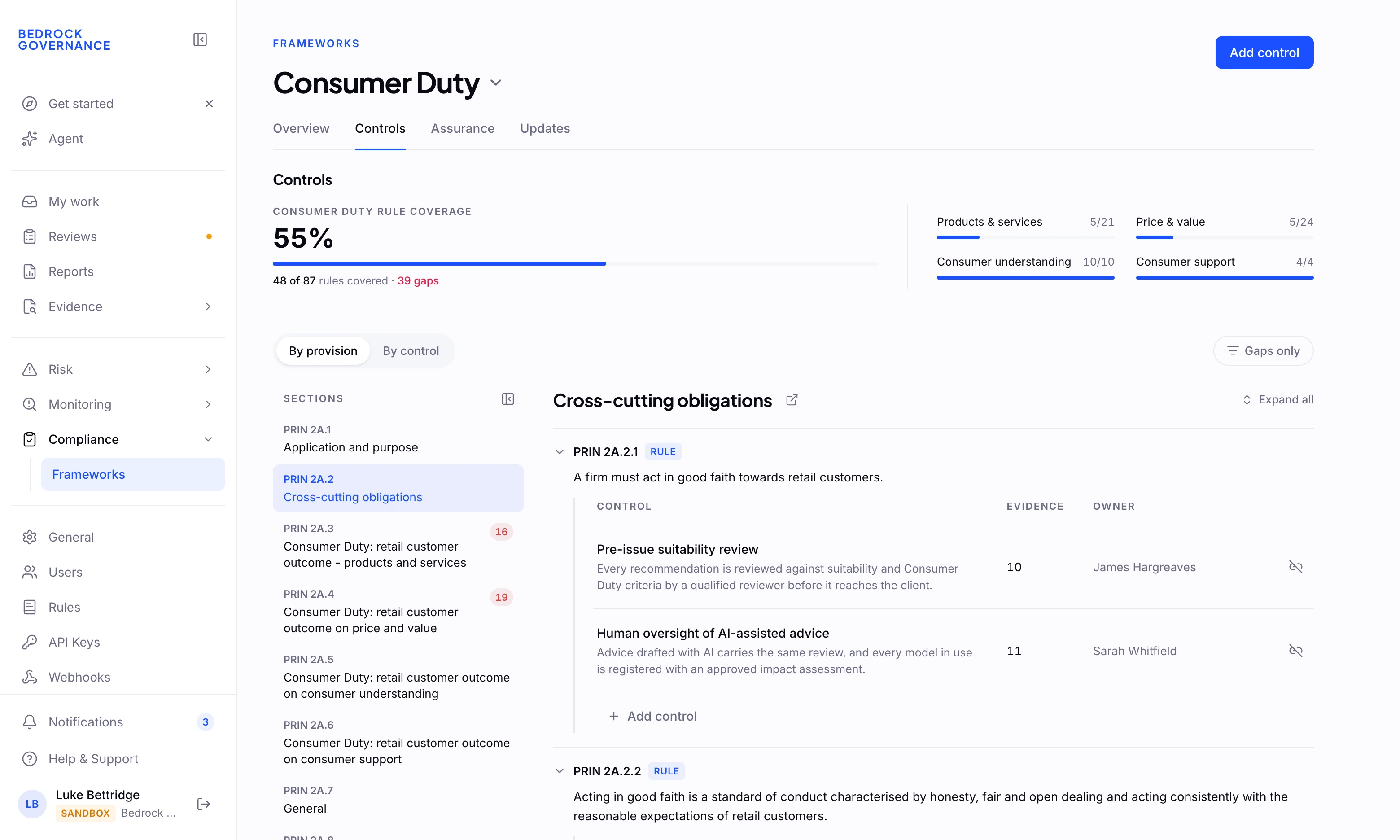
A control matrix is only as good as its evidence.
- The matrix drifts
- A spreadsheet records what was true the last time someone opened it.
- Coverage is a guess
- Without a provision-by-provision view, nobody can say which rules have no control behind them.
- Evidence is gathered late
- Assurance becomes a hunt for screenshots once the period has already closed.
- Sign-off without substance
- A control marked effective means little if nothing shows that it operated.
You own the controls. The record proves they ran.
The mapping stays yours, because only your firm knows how it meets an obligation. What the platform contributes is the evidence, taken from the reviews and decisions already flowing through it.
Pick the framework
Consumer Duty, SM&CR, suitability, or systems and controls, each broken down to the individual provision.
Add your controls
You define what the firm does to meet a provision, who owns it, and how often it is reviewed.
Attach evidence signals
Each control draws on the reviews, decisions, and records already held.
Sign the assurance review
Every control is rated for the period, and anything short of effective raises an action.
What you get.
Rule-by-rule coverage
The share of provisions with a control behind them, and every gap that remains.
Two ways to work
Move down the Handbook section by section, or across your own set of controls.
Named owners
Every control carries an owner and a review cadence, so accountability is explicit.
Evidence signals
Signals read platform events directly, with attestation where judgement is needed.
Signed assurance periods
Each review is signed by a named person and rated control by control.
Actions with owners
Anything short of effective becomes a tracked action against a named person.
Where the rules come from.
Every provision links back to the FCA Handbook. Our rule-by-rule breakdown of what each requirement demands, and the risk of falling short, sits alongside the mapping.
See the regulatory coverage