Evidence
A permanent record of every piece of advice.
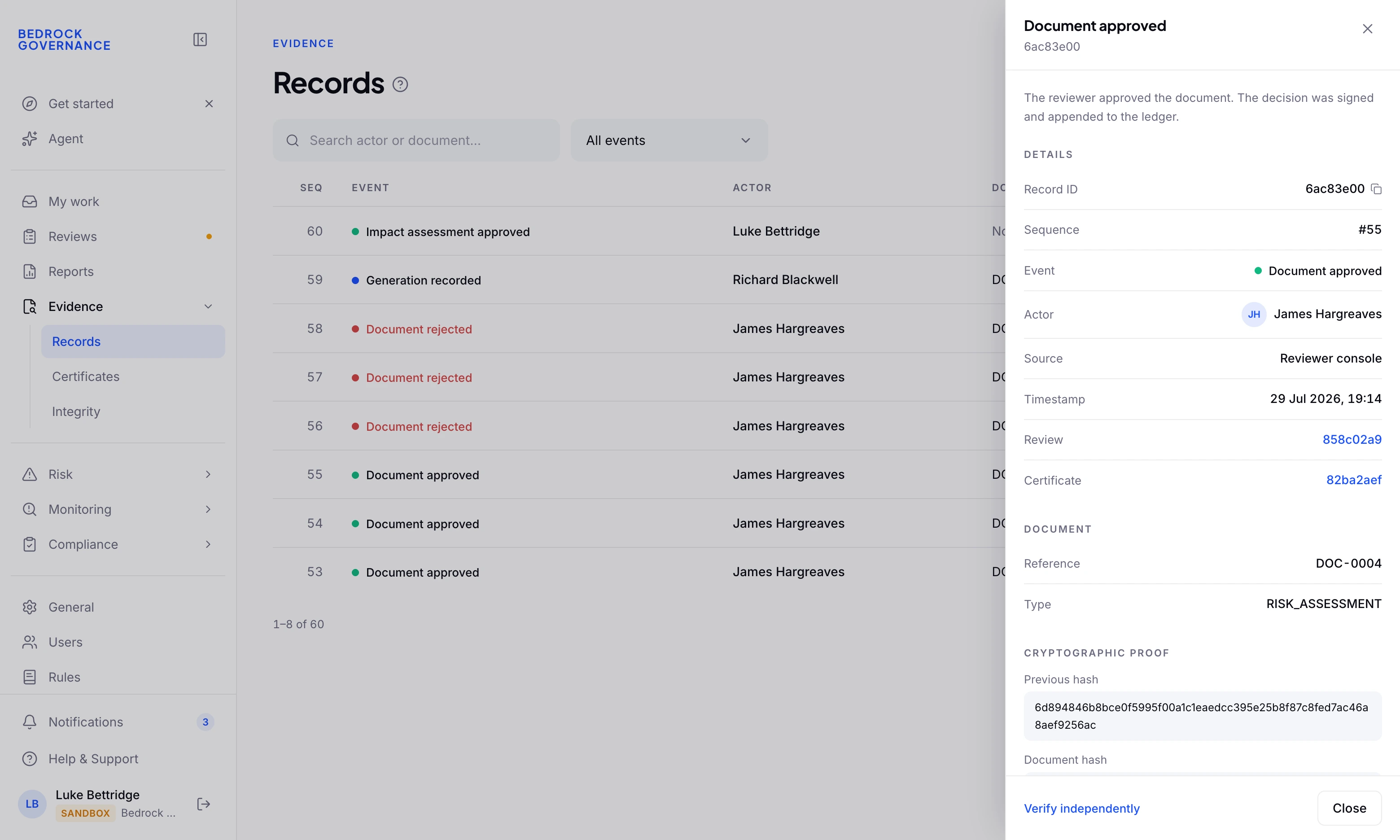
What the evidence layer is.
Think of a logbook where every entry is written in permanent ink, and each page carries a short summary of the page before it. Tear out or change a page and the summaries stop matching, so everyone can tell.
That is the evidence layer, in software. Every piece of advice your firm gives is recorded and linked to everything before it, producing an audit trail that no one, including us, can quietly change.
What happens when advice is recorded.
The advice is captured
Every recommendation is recorded the moment it is produced, with the inputs behind it: the client context and what any AI contributed.
It is linked to the record before it
Each new record is tied to the one before, so the history forms a single connected chain.
It is signed and sealed
The record is signed, then locked so no one can change or delete it, not even us.
It stays provable
From that moment, anyone can confirm the record is genuine and has not been altered.
Why you can trust it.
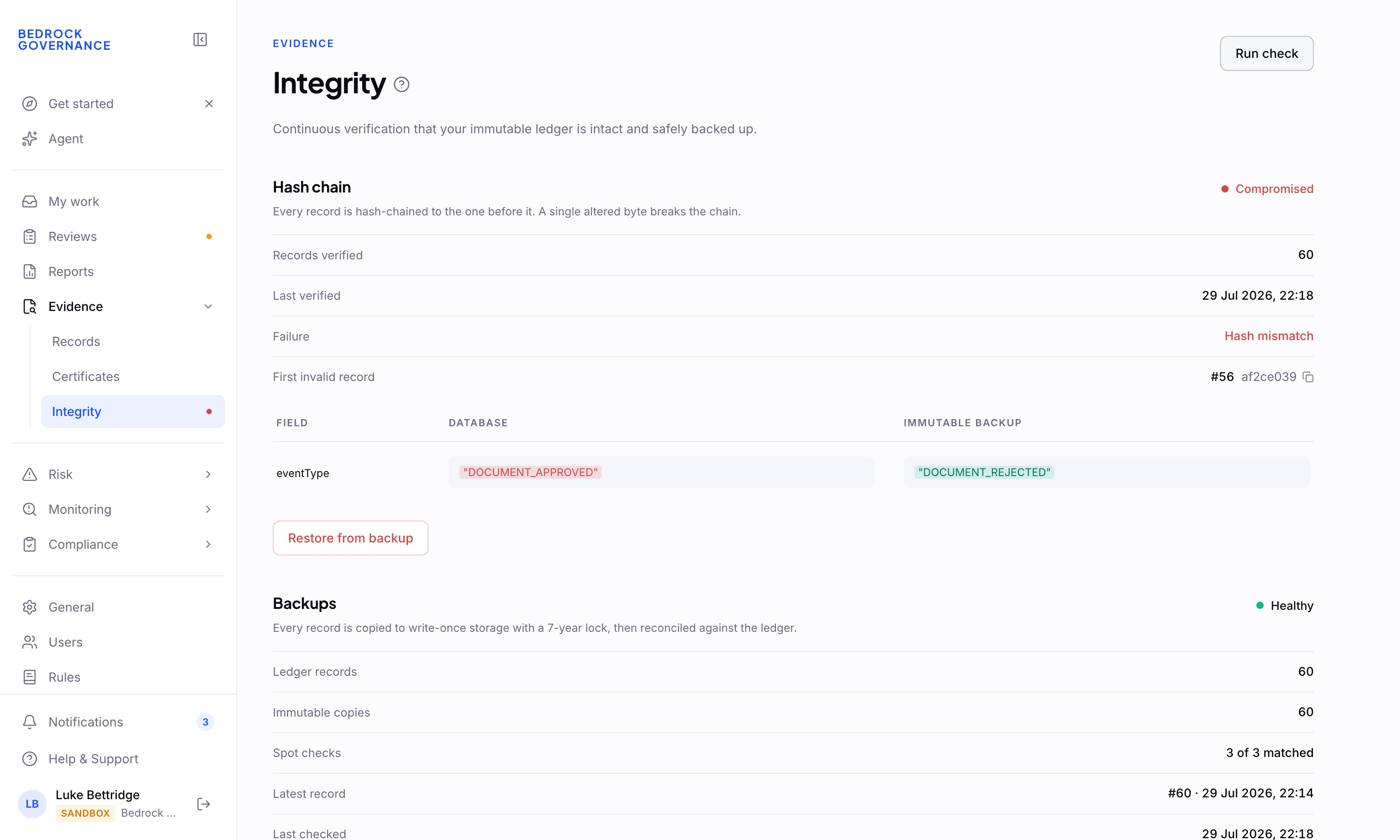
Each record depends on the one before it. Change a single record and everything after it stops matching, so tampering is caught automatically, by anyone, at any time.
Intact chain, every record checks out
Tampered chain, an altered record breaks everything after it
Record 3 was altered. Records 4 and 5 no longer match. The tampering is caught immediately and automatically.
What the record guarantees.
Permanent
Records cannot be altered, deleted, or backdated once written. The record only ever grows.
Tamper-evident
Because each record is linked to the last, any change breaks the chain and is caught immediately.
Signed
Every record is digitally signed, so its authorship and integrity can be proven, not just asserted.
Independently verifiable
Anyone can confirm a record or certificate against the chain, with no account needed, and you can try it yourself.
Governance features
A full governance layer, built on the record.
The same permanent record powers the governance features an FCA-regulated firm needs: Consumer Duty reporting, model registry and drift detection, bias monitoring, incident reporting, vulnerable-customer evidence and more. Every one is mapped to the FCA rule it satisfies.
- Framework controls, evidenced from the record
- Assurance reviews, signed on your own cadence
- Consumer Duty reporting
- Model registry and drift detection
- Bias monitoring
- Incident reporting
- Impact assessments
- Independently verifiable certificates
- Vulnerable-customer evidence
- Review SLAs
- Explainability reports